Enhancing the resolvability of cryo-EM maps in protein-ligand complexes using deep learning
Abstract
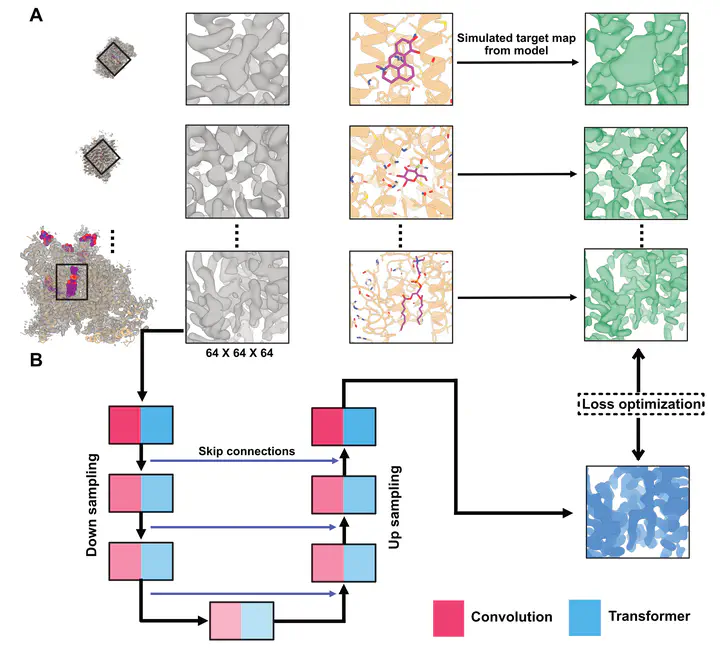
Cryo-electron microscopy (cryo-EM) has become a central tool for structure-based drug discovery, yet ligand-binding sites often remain substantially less well resolved than the surrounding protein, limiting reliable atomic interpretation. Existing deep learning approaches have markedly improved global cryo-EM map quality but are trained predominantly on protein architectures and frequently fail to recover ligand densities. Here we present CryoLigATE, a deep learning framework specifically designed to enhance densities associated with protein-bound ligands in cryo-EM maps. We curated a chemically and structurally diverse dataset of more than 6,000 protein-ligand complexes from the EMDB and PDB, encompassing drug-like molecules, lipids, steroids, carbohydrates and other ligand classes, and trained a hybrid convolutional-transformer network to enhance local density around binding pockets. During inference, CryoLigATE automatically extracts the target region from a preliminary atomic model, requiring no manual map preparation and completing localized refinement in seconds on a desktop GPU. Evaluation on an independent test set of 649 complexes demonstrates substantial improvements in ligand resolvability, particularly for maps with poorly resolved binding sites, while preserving high-quality experimental densities. The enhanced maps recover chemically meaningful features, including ligand functional groups and topological continuity, enabling more confident atomic modeling. By explicitly learning the structural diversity of ligand features, CryoLigATE addresses a longstanding limitation of cryo-EM map enhancement and provides a useful framework for improving structural interpretation and structure-guided drug discovery.
